
Deep Principle Compresses Materials Discovery to Under Three Months With Autonomous AI Factory
Hangzhou, China, November 9th, 2026, Chainwire
Deep Principle says the timeline compression it proved with longtime partner SHINEHIGH Innovation is now being extended across additional industries, from energy to specialty chemicals.
Deep Principle today announced the commercial expansion of its proprietary AI Materials Factory across the specialty chemicals, energy, and electronics sectors, following the successful delivery of an industrial-grade cosmetic active compound for partner SHINEHIGH Innovation in under three months. By pairing generative molecular modeling with automated, around-the-clock physical laboratory verification, the platform compresses multi-year material discovery and synthesis cycles down to weeks, establishing an autonomous, repeatable production standard for commercial material design.
Barriers to Accelerating Materials Discovery
A new material typically takes 10 to 20 years to go from a lab discovery to a store shelf, an estimate significant enough that the U.S. government built an entire initiative, the Materials Genome Initiative, around cutting that timeline in half. Part of the challenge is scale.
“There are more than ten to the sixtieth power possible combinations of elements, and humans have explored only a tiny fraction,” said Dr. Haojun Jia, Co-founder and CEO of Deep Principle.
The rest of the problem is structural. By industry estimates, more than half of experimental materials data remains unstructured, and a majority of researchers report difficulty reproducing a peer’s published results. Even as computational tools have gotten better at predicting promising materials, most of those predictions are never physically verified. Of the roughly 150,000 materials computed in the Materials Project, the field’s largest open database of AI and computationally predicted materials, only about 23,000 have ever been experimentally observed to actually exist.
Closing the Loop Between Prediction and Proof
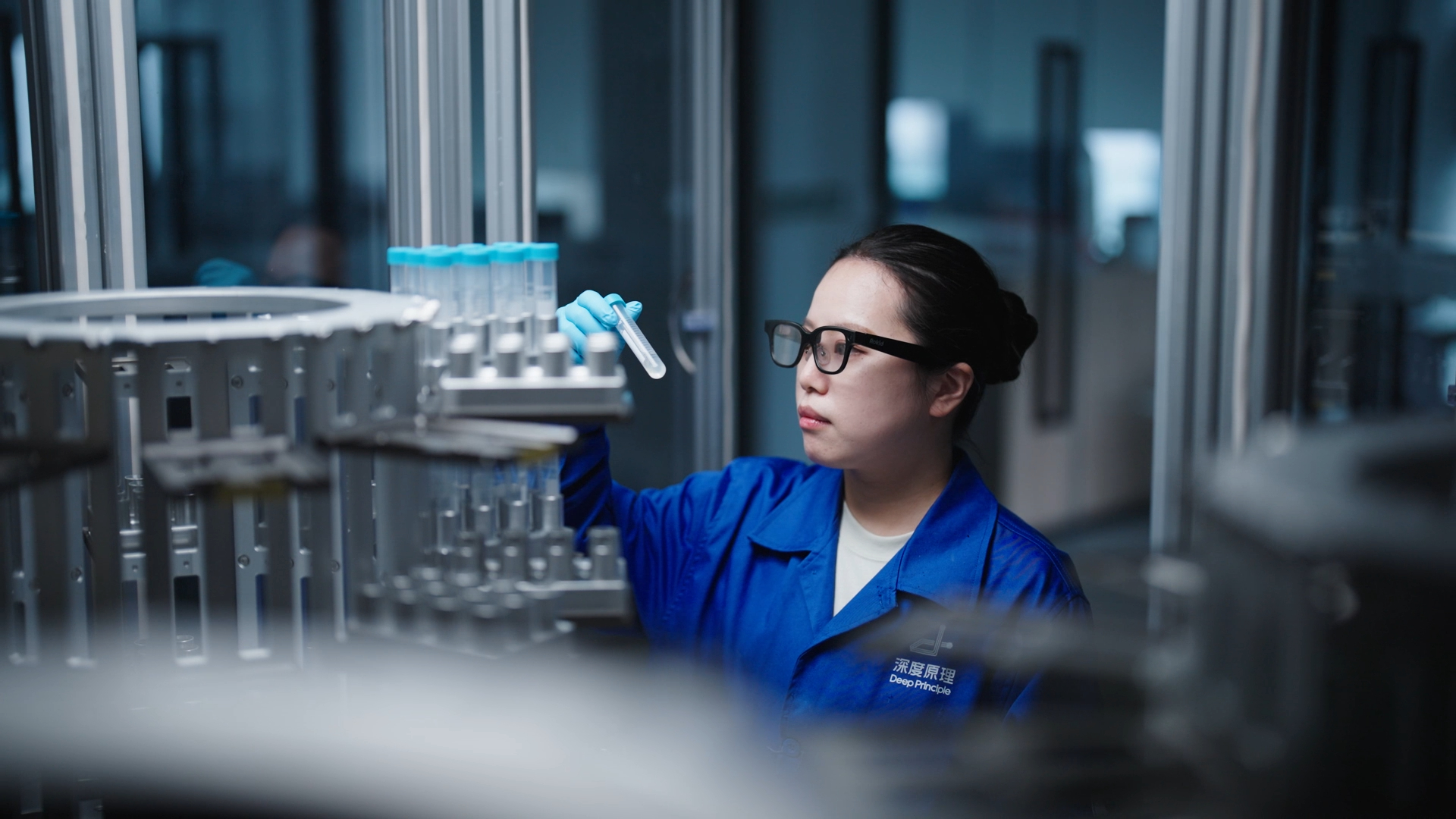
Deep Principle’s answer has been to build the physical verification step in-house rather than stopping at software. The company’s AI Materials Factory is an autonomous, high-throughput lab that runs around the clock, testing AI-generated candidates and feeding the results back into the model automatically.
“By bringing physical verification in-house, we close the gap between what AI predicts and what science can prove. Our AI Materials Factory allows us to test candidates continuously, feed real-world results back into our models, and accelerate the journey from computational discovery to commercially viable materials. It’s how we turn promising predictions into proven outcomes”, Jia added.
The SHINEHIGH partnership is the company’s clearest evidence that the approach works at commercial scale. Deep Principle generated and evaluated candidate materials computationally, then verified the strongest ones experimentally, compressing a process that traditionally unfolds over years into a matter of months.
Deep Principle says it is now applying the same closed-loop approach across additional industries, including energy, electronics, and specialty chemicals, extending the compressed timeline it proved with SHINEHIGH to a broader set of clients.
For more information on Deep Principle, visit deepprinciple.com.
About Deep Principle
Deep Principle is an AI materials company headquartered in Hangzhou, China, and founded in 2024 by MIT PhDs Dr. Haojun Jia and Dr. Chenru Duan. The company combines generative AI
with computational chemistry and an in-house autonomous research lab to move new materials from prediction to physical validation.
Deep Principle has raised over $100 million over multiple funding rounds. The company was named to the World Economic Forum’s 2025 Technology Pioneers cohort, and its research has appeared as cover papers in Nature Computational Science and Nature Machine Intelligence.
Learn more at deepprinciple.com.
Email: info@deepprinciple.com