
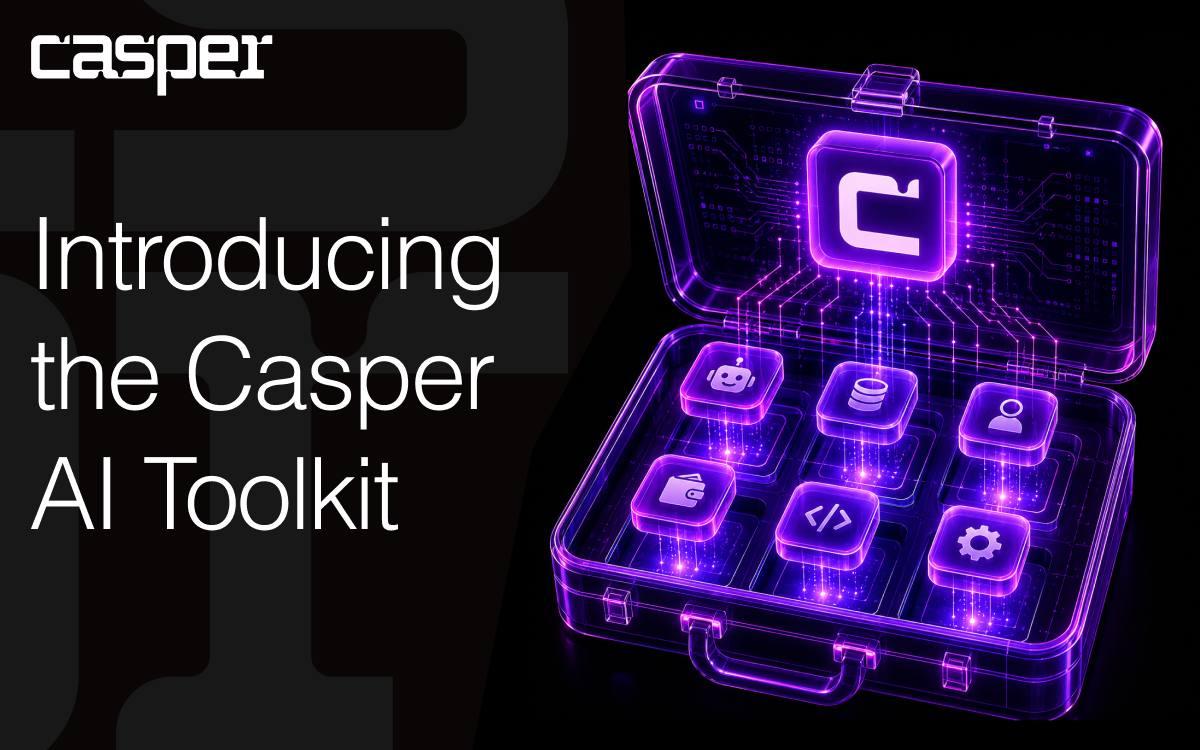
Casper Network Launches AI Toolkit, Becoming First WebAssembly-Native Blockchain with Live X402 Payments
Zug, Switzerland, June 4th, 2026, Chainwire
First initiative of the Casper Manifest ships to mainnet; $150,000 Agentic Buildathon kicks off at Istanbul Blockchain Week
The Casper Association today launched the Casper AI Toolkit — the most comprehensive AI offering of any Layer 1 blockchain. It enables AI agents to do two things no other L1 stack fully supports in production today: transact autonomously as economic actors, and write, test, and deploy new applications without human guidance. Both capabilities are live on mainnet now, anchored by a production x402 Facilitator that makes Casper the first WebAssembly-native Layer 1 with live HTTP-based micropayment infrastructure for AI agents.
This is the first shipped initiative from the Casper Manifest, the network’s multi-year technical roadmap published in May 2026. Where the Manifest set out where Casper is headed, the AI Toolkit is the first piece of it already in developers’ hands.
AI Agents as Economic Actors
Start with the agent as a participant in the economy. AI agents already buy data, pay for compute, execute trades, and settle transactions thousands of times a day, without human involvement. What they cannot do is sign a subscription, negotiate with a salesperson, or submit a purchase order. They need to pay per request: call an API, pay three-tenths of a cent, get the response, move on.
Casper gives them a way in. With the x402 protocol, payment becomes part of the request itself — an agent calls a paid endpoint, receives an HTTP 402 response and a price, signs an authorization, and has its data back in seconds. No API keys, no billing accounts, no human in the loop. The Casper x402 Facilitator settles all of it on-chain and is live on mainnet today, with the Casper Association a member of the X402 Foundation.
Paying is only half of acting. Through the Model Context Protocol (MCP) — the standard by which AI models discover and invoke external tools — agents reach directly into the chain: querying balances, submitting transactions, reading contract state, and monitoring transfers through real-time event streams. The CSPR.trade MCP Server takes that further, turning agents into advanced DeFi users on Casper that swap, provide liquidity, and manage portfolios entirely through natural language.
But an economy needs more than participants — it needs the services they transact with. That is the agent’s second role.
AI Agents as Developers and Builders
The same toolkit that lets an agent spend on Casper lets it build on Casper. With the Odra Framework, Casper’s developer-friendly smart contract toolkit, an AI coding agent can write, test, and deploy smart contracts entirely on its own — point it at Odra, and it goes from idea to production-ready, deployed contract without human guidance.
Around that, the CSPR.build Agent Skills supply the rest of the integration in a single installable package: wallet connections, transaction signing, event handling, and CSPR.cloud API access — backed by enterprise-grade middleware across CSPR.cloud’s REST, Streaming, and Node API layers, giving agents everything they need to read from and write to Casper at scale.
The result closes a loop: the services one agent builds become the services another agent pays to use. Transacting and building are not two separate products — they are two ends of the same machine economy.
Built to work as a system
The AI Toolkit is a single, coherent stack, and its pieces are designed to compound. An agent uses MCP to discover what it can do on Casper, x402 to pay for the services it consumes, the CSPR.trade MCP server to act in DeFi, and Odra together with the CSPR.build Skills to ship the next application that other agents will use.
The Manifest charts the next step from here: account abstraction — a planned protocol enhancement under which user accounts and smart contracts share a single on-chain data model. Once delivered, it will give agents their own on-chain identity, scoped spending permissions, and predictable fixed-cost transactions, with no human wallet in the loop — completing the picture of agents as fully native participants on Casper.
This is the machine economy thesis the Casper Manifest described, and with the AI Toolkit the first of it is buildable today.
$150,000 Agentic Buildathon
To put real resources behind developers building with the AI Toolkit, the Casper Association has launched the Casper Agentic Buildathon with $150,000 in prizes. Participating teams receive sponsored x402 Facilitator usage — free on-chain transactions — so they can build and test micropayment-powered applications without upfront costs.
“No other Layer 1 gives AI agents both the ability to transact as economic actors and to autonomously build new applications — in production, on mainnet, today,” said Michael Steuer, President and CTO of the Casper Association. “Billions of AI agents are operating right now with no native way to pay for services — every transaction still runs through infrastructure built for humans, not machines. The Casper AI Toolkit changes that: agents can pay per request in seconds with cryptographic proof, and they can write and deploy smart contracts without any human in the loop. That is what the machine economy actually looks like. And with $150,000 in prizes and sponsored x402 usage for winning teams, we are putting our resources directly behind the developers building it.”
The buildathon kicked off with a hands-on developer workshop at Istanbul Blockchain Week on June 2, where teams built their first x402-powered agents live on Casper Network. Competition tracks span Agentic AI, DeFi and Payments, Cross-Chain, and RWA Tokenization.
About Casper Network
Casper Network (CSPR) is a layer 1 Proof-of-Stake blockchain engineered for regulated real-world assets and the machine economy. With deterministic transaction finality, a multi-VM execution layer supporting both WebAssembly and soon EVM smart contracts, and fixed-cost operations enforced at the protocol level, Casper delivers the infrastructure for compliant asset tokenization, frictionless consumer experiences, and autonomous machine-to-machine commerce. The Casper Manifest – the network’s multi-year technical roadmap – advances nine coordinated protocol initiatives spanning developer access, user experience, institutional compliance, privacy, micropayments, and quantum safety. The Casper Association, a non-profit organization based in Zug, Switzerland, oversees protocol development and ecosystem growth. Learn more at https://casper.network.
Casper AI Toolkit: https://casper.network/ai
Casper Manifest: https://casper.network/news/manifest
Casper Agentic Buildathon: https://dorahacks.io/hackathon/2202/detail