
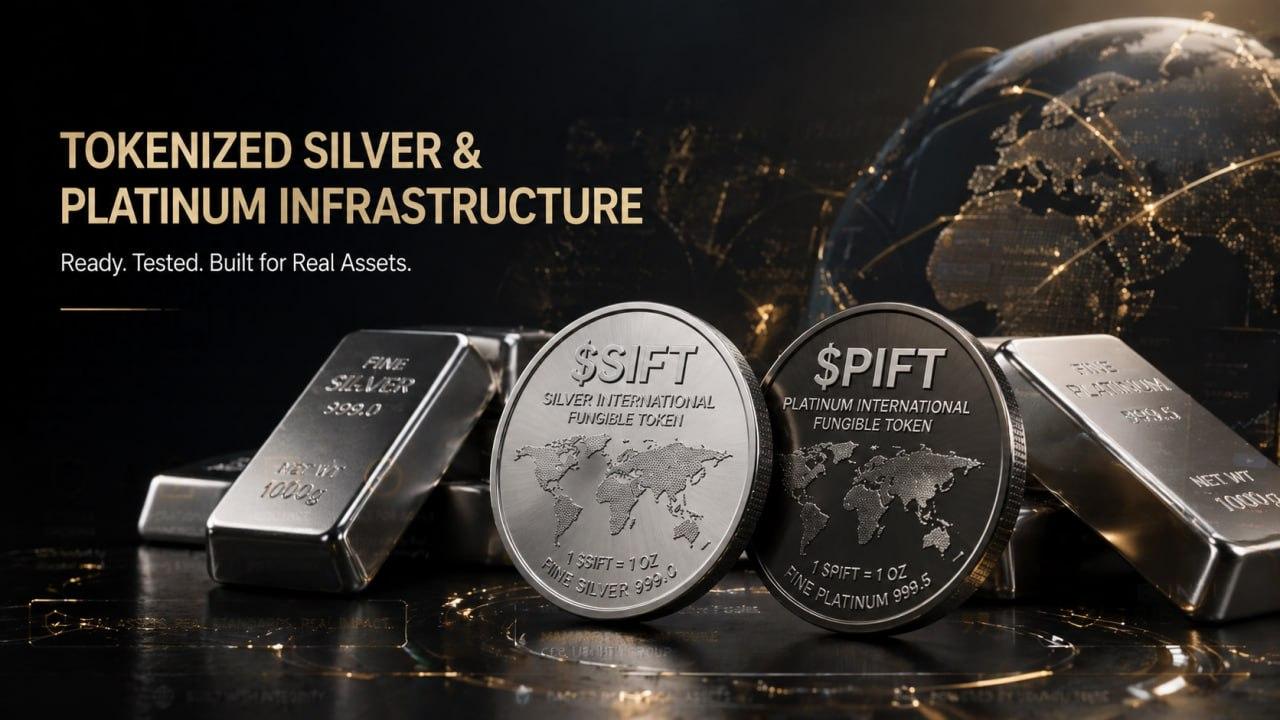
Ubuntu Group Enters Final Testing Phase for Tokenized Silver ($SIFT) and Platinum ($PIFT) Infrastructure
Ebene, Mauritius, May 5th, 2026, Chainwire
Ubuntu Group today confirmed that the core infrastructure supporting its tokenized silver and platinum assets—$SIFT (Silver International Fungible Token) and $PIFT (Platinum International Fungible Token)—has been completed from a development standpoint and has entered final testing and user‑interface (UI) finalisation.
The milestone represents a continued execution of Ubuntu Group’s broader strategy: building real‑asset digital infrastructure with the same standards applied in traditional commodity custody and issuance, rather than treating tokenization as a rapid product‑launch exercise.
$SIFT and $PIFT are being developed within the Ubuntu Tribe ecosystem as part of a multi‑metal architecture that extends beyond price exposure, prioritising physical backing, operational controls, and issuance discipline over speed to market.
“Tokenizing a metal is not difficult. Doing it responsibly is,” said Mamadou Kwidjim Toure, CEO of Ubuntu Group. “From the start, we made a decision not to compete on headlines or timelines, but on structure. Silver and platinum follow the same rule book as gold: the system must work before it scales.”
A Structural Difference in How Tokenized Metals Are Built
Across the tokenized commodities landscape, many offerings are primarily designed as price‑tracking instruments, where digital supply is loosely coupled to physical assets, often relying on aggregate disclosures, issuer attestations, or redemption mechanisms that are technically available but rarely exercised.
Ubuntu Group has taken a structurally different approach.
$SIFT and $PIFT are being built on infrastructure designed to mirror real‑world commodity processes, where:
- Digital issuance is conceived as a reflection of custody and procurement processes, not as a standalone financial product
- Asset backing is treated as an operational constraint rather than a marketing feature
- Growth is limited by verified readiness rather than market demand alone
This philosophy has shaped both the internal sequencing and the current status update. While core development is complete, Ubuntu Group has deliberately held back from announcing public availability until testing, UI alignment, and internal controls meet the same standards applied to its gold rails.
“In commodities, credibility is cumulative,” Toure added. “You don’t build it with dashboards. You build it with process, restraint, and repeatability.”
Extending the Same Discipline Beyond Gold
Silver and platinum introduce additional complexity compared to gold, combining industrial demand, tighter sourcing dynamics, and different liquidity characteristics. Ubuntu Group’s decision to proceed deliberately reflects an understanding that tokenizing these metals without robust operational foundations risks recreating the same opacity tokenization is meant to resolve.
As with gold, the $SIFT and $PIFT infrastructure has been designed around:
- Conservative issuance assumptions
- Segmentation between infrastructure readiness and market rollout
- Clear internal separation between development, testing, and deployment stages
The current phase focuses specifically on:
- System‑level testing under operational conditions
- User‑interface finalisation aligned with Ubuntu Tribe’s education‑first design principles
- Internal review of issuance logic, reserve workflows, and exception handling
This update does not constitute a public launch announcement. Ubuntu Group reiterated that any future rollout of $SIFT or $PIFT will only occur once testing and oversight thresholds are formally cleared.
A Platform Mindset, Not a Product Race
Unlike issuers focused on individual metals as standalone instruments, Ubuntu Group continues to position itself as a real‑asset platform, where gold, silver, and platinum are implemented as coordinated components rather than isolated products.
That distinction shapes how the Group measures progress. Readiness is assessed internally based on:
- Whether assets can be issued, held, and redeemed without stress to the system
- Whether operational controls hold under audit and abnormal conditions
- Whether end users can understand and interact with the product without relying on speculative behaviour
“If the only thing a user understands is price movement, we’ve failed,” Toure noted. “Real assets should anchor participation, not encourage momentum.”
Looking Ahead
With gold operational and silver and platinum now in advanced stages of readiness, Ubuntu Group continues to advance a measured multi‑metal roadmap focused on durability rather than expansion for its own sake.
Further updates will be communicated exclusively through official Ubuntu Group and Ubuntu Tribe channels as additional readiness milestones are achieved.
About Ubuntu Group
Ubuntu Group is an organization focused on the development of tokenized commodity and real‑world asset solutions, with an initial emphasis on physically backed precious metals. Through its Ubuntu Tribe platform, the Group provides access to tokenized metals backed on a one‑to‑one basis by fully allocated physical inventory, held in insured and audited third‑party vaults.
Each token is directly linked to identifiable physical metal, ensuring alignment between digital assets and underlying holdings. Ubuntu Group operates with a strong focus on transparency, verifiability, and building trust between on‑chain instruments and real‑world assets.