
Jumper Exchange Expands Cross-Chain Routing Infrastructure to Address Fragmented Liquidity
Berlin, Germany, February 18th, 2026, Chainwire
Jumper Exchange has expanded its cross-chain routing infrastructure to simplify asset transfers across more than 50 blockchain networks, consolidating access to decentralized exchanges and bridge protocols within a single interface.
As decentralized finance protocols have expanded across blockchains, including Ethereum, Arbitrum, Base, Solana, and Hyperliquid, liquidity has become increasingly distributed. This fragmentation creates operational friction for retail users who must navigate multiple bridges, manage gas tokens on different chains, and compare execution paths manually when moving capital between ecosystems.
Cross-chain asset transfers typically involve several cost and time considerations. Bridge protocol fees can range from 0.5% to 1% of the transfer amount, while gas costs vary significantly by network. Transaction finality times also differ by chain, with some routes requiring 20 minutes or more for completion.
For retail investors evaluating whether to move capital to access yield opportunities or lower trading costs on alternative chains, these combined factors often discourage reallocation even when economically favorable opportunities exist elsewhere.
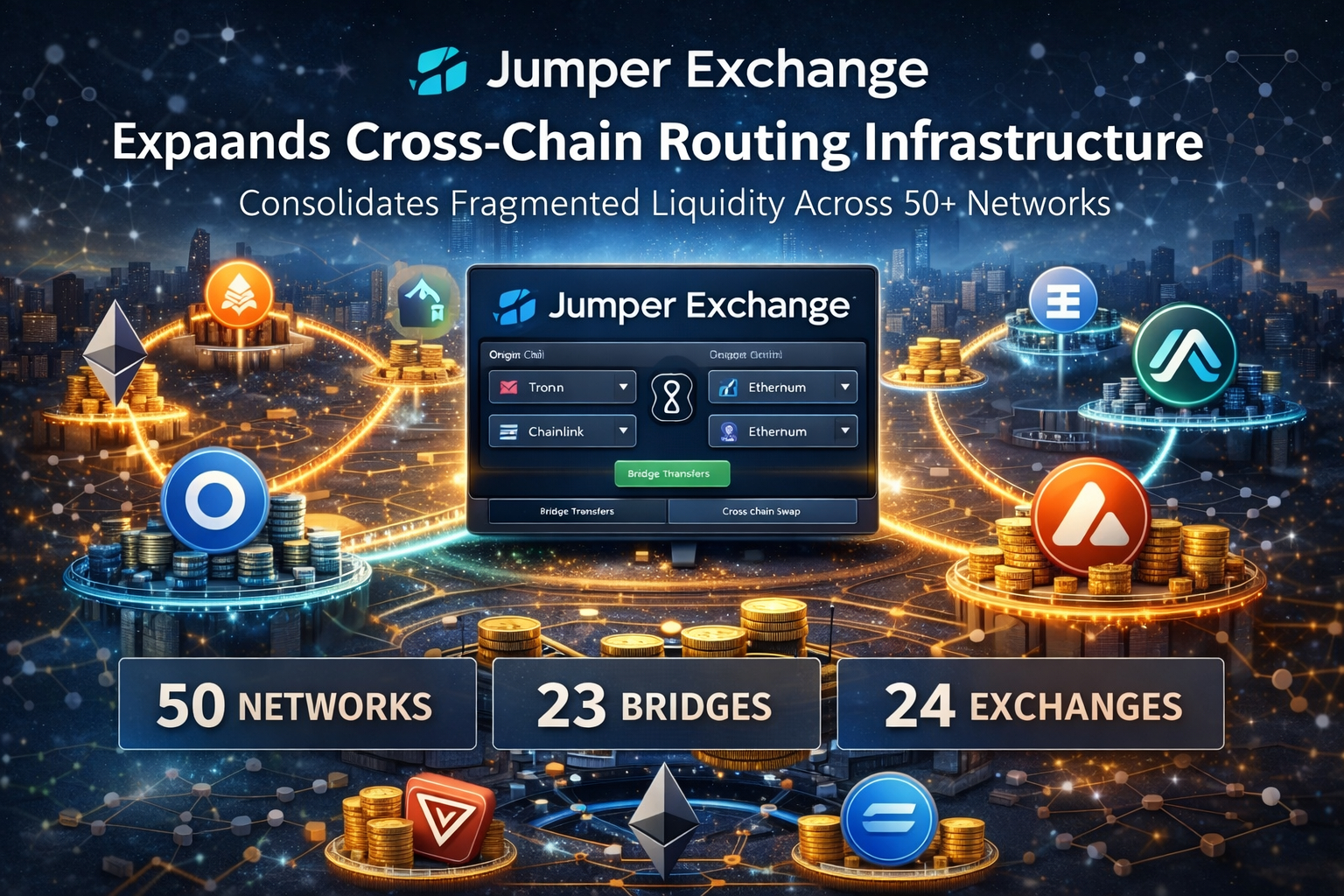
Jumper Exchange, a cross-chain trading aggregator, has built routing infrastructure designed to reduce this complexity. The platform integrates 23 bridge protocols and 24 decentralized exchanges across more than 50 networks, enabling users to execute cross-chain transfers through a single interface rather than coordinating multiple transactions across separate platforms.
“Many people still see cross-chain swaps as complex or risky because there are so many protocols and bridges to navigate,” said Jordan Neary, Marketing Lead at Jumper Exchange. “By abstracting that complexity away and clearly showing the route and expected output, we want to make it easier for users to feel comfortable moving liquidity wherever they need it.”
The platform’s routing engine evaluates available paths based on current network conditions, optimizing for execution cost, speed, and bridge track record. Users select origin and destination assets, then receive an automatically generated route with transparent fee breakdowns, expected output amounts, and estimated completion times. The system is designed to handle underlying technical requirements—such as determining bridge compatibility, managing intermediate swaps, and monitoring transaction finality—while presenting users with a simplified execution flow.
This approach has particular relevance for users accessing newer specialized chains. Moving capital from established networks to platforms such as Hyperliquid, a custom Layer 1 optimized for perpetuals trading, traditionally required multiple manual steps, including asset swaps, bridge selection, and potential post-arrival conversions. For users evaluating where can I bridge to Hyperliquid, aggregation simplifies the process to a single routing decision.
Jumper Exchange also supports gasless transactions on certain routes, removing the requirement for users to maintain native token balances on every chain they interact with. This addresses a coordination challenge that can discourage cross-chain activity, particularly for retail participants managing smaller capital allocations.
The company recently expanded routing support to include perpetuals trading venues across HyperEVM, Hyperliquid, Base, and BNB Chain, reflecting demand for simplified access to decentralized derivatives markets as they develop outside Ethereum’s ecosystem.
About Jumper Exchange
Jumper Exchange is a cross-chain trading aggregator that enables users to swap and bridge digital assets across more than 50 networks through a single interface.
By integrating leading decentralized exchanges and bridges, Jumper Exchange focuses on delivering efficient execution and a simplified multi-chain user experience, while remaining fully non-custodial and permissionless.