
CredShields Leads OWASP Smart Contract Top 10 2026 to Raise Smart Contract Security Standards
SINGAPORE, Singapore, February 18th, 2026, Chainwire
The OWASP Smart Contract Security Project has released the OWASP Smart Contract Top 10 2026, a forward looking risk prioritization framework grounded in analysis of smart contract incidents from 2025 and previous years, representing millions in contract related losses.
The 2026 edition reflects structured aggregation of real world exploit data and practitioner input from auditors, protocol security leads, infrastructure engineers, and incident responders.
CredShields, supported by its research and exploit intelligence platforms including SolidityScan and Web3HackHub, led the structured incident aggregation and pattern analysis that informed this year’s ranking.
The analysis incorporated exploit pattern clustering and impact weighted ranking signals from previous year incident data.
The 2026 Top 10 moves beyond static checklists, capturing the failure patterns observed in production systems.
Where Smart Contracts Truly Break
The highest ranked risks for 2026 signal a shift from isolated code errors toward systemic failure modes:
- SC01: Access Control Vulnerabilities
- SC02: Business Logic Vulnerabilities
- SC03: Price Oracle Manipulation
- SC04: Flash Loan Facilitated Attacks
- […]
- SC10: Proxy & Upgradeability Vulnerabilities
Referring image below.
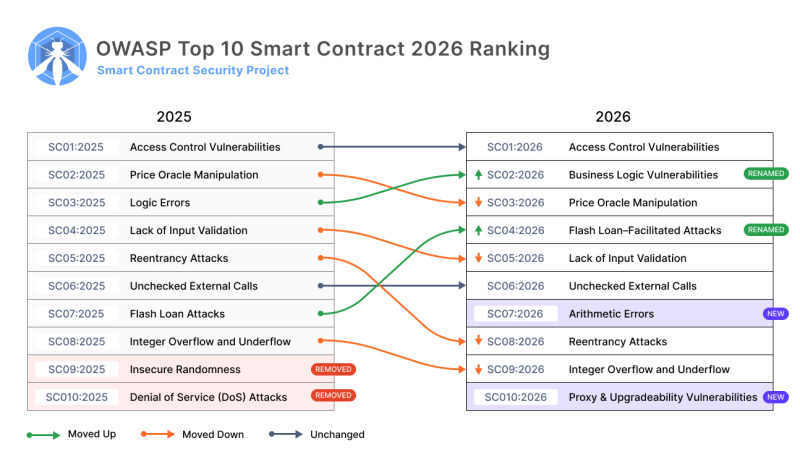
The full OWASP Smart Contract Top 10 2026 framework, methodology, and data sources are available on the official OWASP Smart Contract Security Project page.
Access control and governance misconfigurations continue to drive full protocol compromise, particularly in upgradeable systems. Business logic vulnerabilities, often embedded in lending markets and AMM mechanics, demonstrate how economically valid code can still break under adversarial pressure.
Last year, multiple high profile incidents reinforced this pattern. Several protocol compromises stemmed not from cryptographic flaws, but from exposed admin roles, upgrade key mismanagement, or insufficient privilege separation.
Price oracle manipulation and cross chain timing discrepancies also enabled multi million dollar extraction events, demonstrating that integration risk often exceeds contract level bugs.
For example, cross chain MEV exploitation events in 2025 demonstrated how source chain information leakage could enable sandwich attacks before transactions reached destination mempools, extracting millions without direct contract vulnerabilities.
The pattern is consistent, contracts pass audits, but production assumptions fail.
A Framework for Production Systems
The 2026 ranking is explicitly forward looking. It derives its structure from 2025 breach data and projects which failure classes are most likely to cause material loss in the upcoming year.
For protocol teams, this reframes security from reactive patching to design time risk modeling.
For institutional allocators and infrastructure partners, the Top 10 provides a structured lens to evaluate smart contract exposure beyond the presence of an audit report.
As capital participation increases and onchain systems become more interconnected, standardized risk taxonomies are becoming foundational to:
- Threat modeling
- Audit scoping
- Upgrade governance
- Due diligence processes
- SDLC integration
Beyond Smart Contracts
The release also recognizes that some of the largest 2025 losses stemmed from operational vectors, including multisig compromise, governance manipulation, and supply chain exposure. An accompanying Alternate Top 15 Web3 Attack Vectors broadens the threat model beyond contract code, reinforcing that resilient systems require layered controls.
The OWASP Smart Contract Top 10 2026 is licensed under CC BY-NC-SA 4.0 and is publicly available through the OWASP Smart Contract Security Project.
As blockchain infrastructure matures, the industry is moving from awareness toward standardization. The 2026 Top 10 reflects that shift.
About OWASP
The Open Worldwide Application Security Project (OWASP) is a nonprofit foundation dedicated to improving software security for over 25 years. Through community-led projects, standards, documentation, and research initiatives, OWASP provides open resources that help organizations develop, acquire, and maintain secure applications. The OWASP Smart Contract Security Project focuses specifically on identifying and standardizing risks in blockchain and decentralized systems.
About CredShields
CredShields is a security research and technology company advancing resilience across both traditional application environments and Web3 infrastructure. Through its platforms, including SolidityScan and Web3HackHub, CredShields combines deep security research, exploit intelligence, automated analysis, and protocol level risk assessment to help enterprises, institutions, and blockchain teams build and maintain secure production systems.