

Orokai Releases Research on Non-Custodial DeFi Adoption and Structural Barriers
Dubai, United Arab Emirates, February 2nd, 2026, Chainwire
Orokai has released a research summary analyzing the current use of non-custodial decentralized finance (DeFi) is currently used and which structural factors continue to limit broader adoption.
The research analyzes protocol-level incentive mechanisms, user responsibility in non-custodial systems, and the role of aggregation layers in reducing operational complexity while preserving asset custody.
As global politics and macroeconomic trends remain uncertain and inflation continues to shape global market conditions, both retail and institutional investors are increasingly looking beyond traditional banking products. Savings accounts and other conventional financial instruments often struggle to preserve value in real terms, prompting interest in alternative on-chain models. In the digital asset space, non-custodial DeFi is increasingly used for practical financial activities such as staking, borrowing, trading, and asset management.
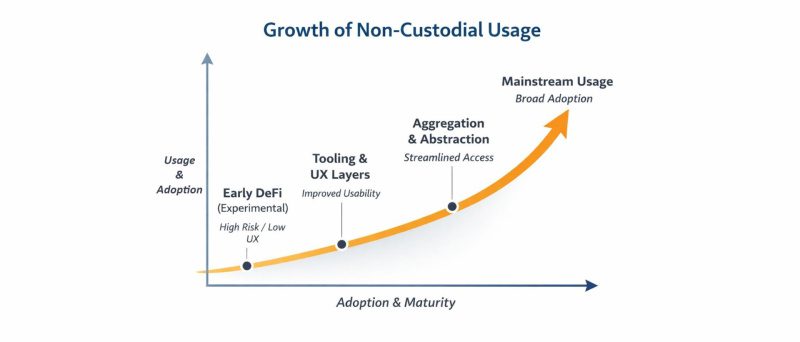
Internal research conducted by Orokai suggests the sector is moving beyond its early experimental phase toward more structured forms of on-chain participation. Understanding this shift, however, requires rethinking how asset custody works in a non-custodial environment.
The Paradigm Shift: From Intermediaries to Code
In traditional finance, generating recurring financial exposure through stock dividends, bond coupons, or savings account interest typically involves relinquishing control to an intermediary. Banks and asset managers hold assets, execute transactions, and determine access conditions. While widely used, this model has long been associated with counterparty risk, conflicts of interest, and operational limitations.
Non-custodial DeFi follows a different approach. Assets remain in user-controlled wallets and interact directly with blockchain protocols through smart contracts.
“The defining characteristic of this model is sovereignty,” the Orokai team stated. “Participants are not requesting access to their own funds. They interact with predefined, immutable code that executes automatically and continuously.”
Deconstructing the Four Pillars of DeFi Mechanisms
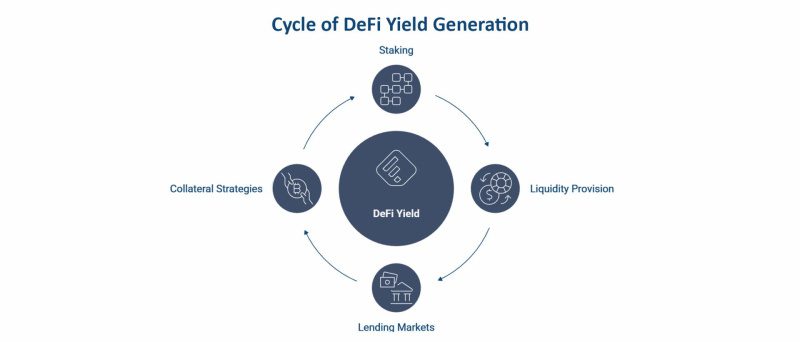
To understand how these systems function in practice, the research examines several core mechanisms commonly associated with non-custodial DeFi:
- Staking: Assets are committed to support Proof-of-Stake networks, with rewards distributed according to protocol-defined rules.
- Liquidity Provision: Assets are supplied to decentralized exchange pools, with transaction fees distributed algorithmically.
- Lending Markets: Capital is supplied directly to borrowers via over-collateralized smart contracts, reducing credit risk through code rather than discretion.
- Collateral Strategies: Existing holdings are used as collateral to access additional on-chain liquidity without selling the underlying assets.
The Barrier to Entry: Complexity and Fragmentation
The research highlights operational complexity as a primary barrier to broader adoption. Fragmentation across protocols, inconsistent interfaces, and the time required to assess risks continue to limit participation.
“Time is the most limited resource for any investor,” the Orokai team noted. “Spending weeks reviewing protocol documentation, audits, and transaction costs across different networks is not practical for most participants. This complexity is still a major barrier to broader adoption.”
Aggregation as the Solution
As part of the research, Orokai outlined its aggregation-first approach, designed to consolidate access to selected non-custodial protocols while leaving asset custody fully with users.
Rather than holding funds, aggregation layers aim to reduce operational friction by standardizing interaction flows and abstracting technical complexity.
A Focus on Transparency and Security
As the sector matures, attention is moving away from unsustainable headline yields toward transparency and risk awareness. On-chain systems make every transaction publicly verifiable, allowing participants to assess activity directly rather than relying on intermediaries.
“The ongoing shift toward non-custodial and transparent on-chain systems is reshaping how yield mechanisms are designed and accessed,” the Orokai team stated.
About Orokai
Orokai is a non-custodial DeFi platform designed as a hub for accessing decentralized finance. By aggregating vetted opportunities in staking, lending, and yield farming, Orokai aims to simplify interaction with selected on-chain protocols, while leaving asset custody with users.
For more information, users can visit: https://orokai.com